Commodore 1541 for TRULY Floppy Audio 5 1/4"
Hey everyone!
I've been watching this thread with interest as well as Jeri Ellsworth's video.
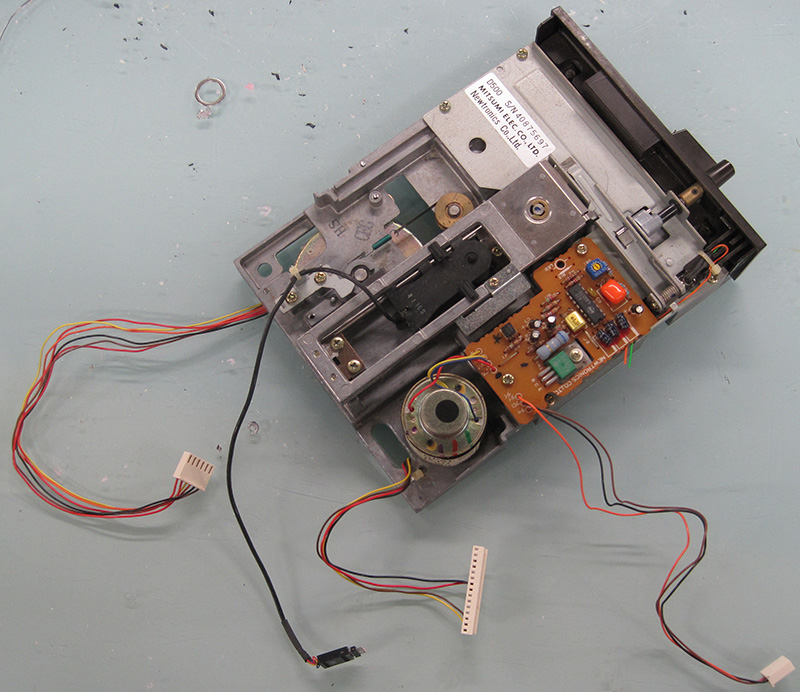
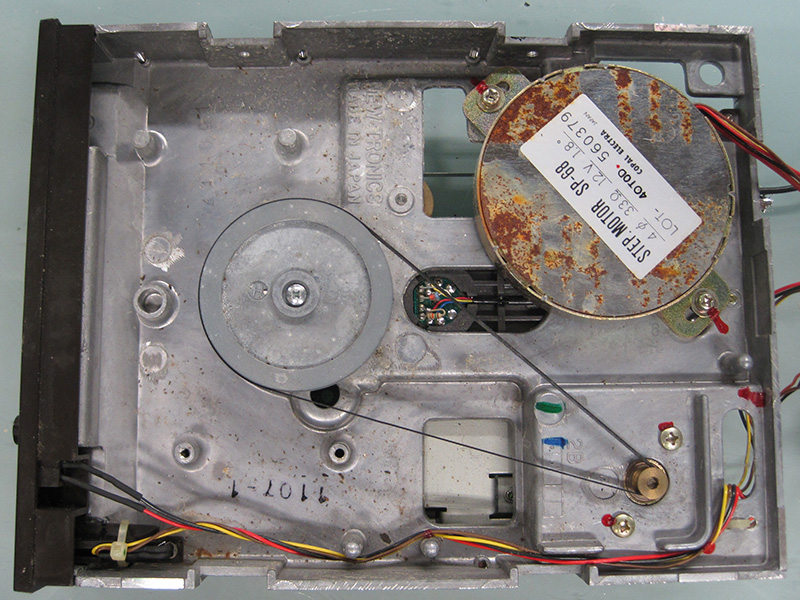
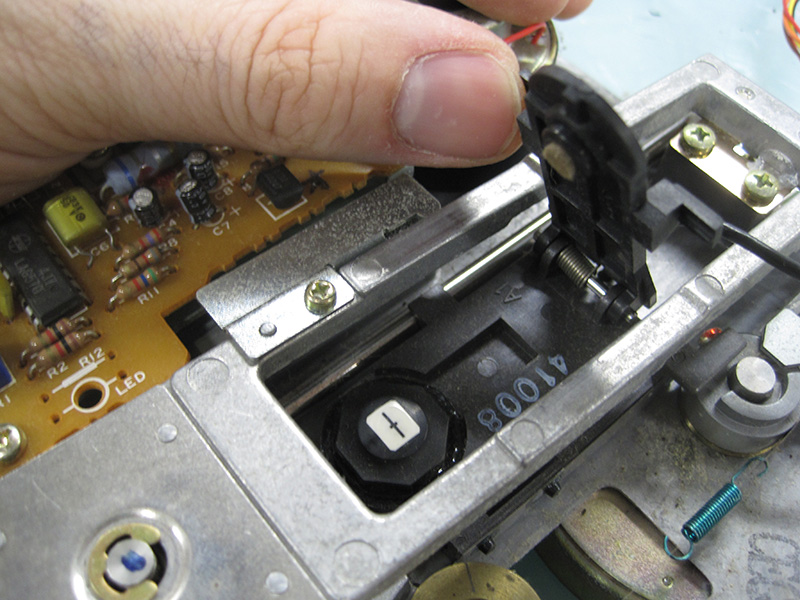
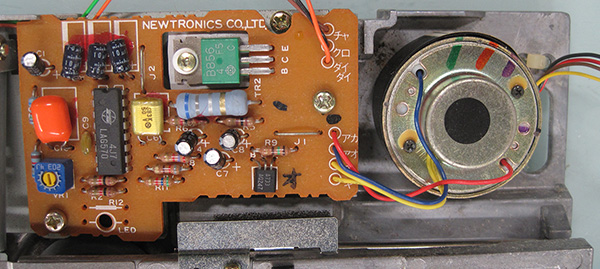
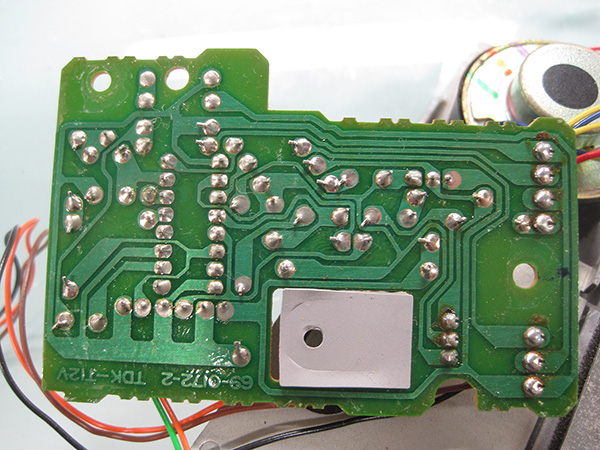
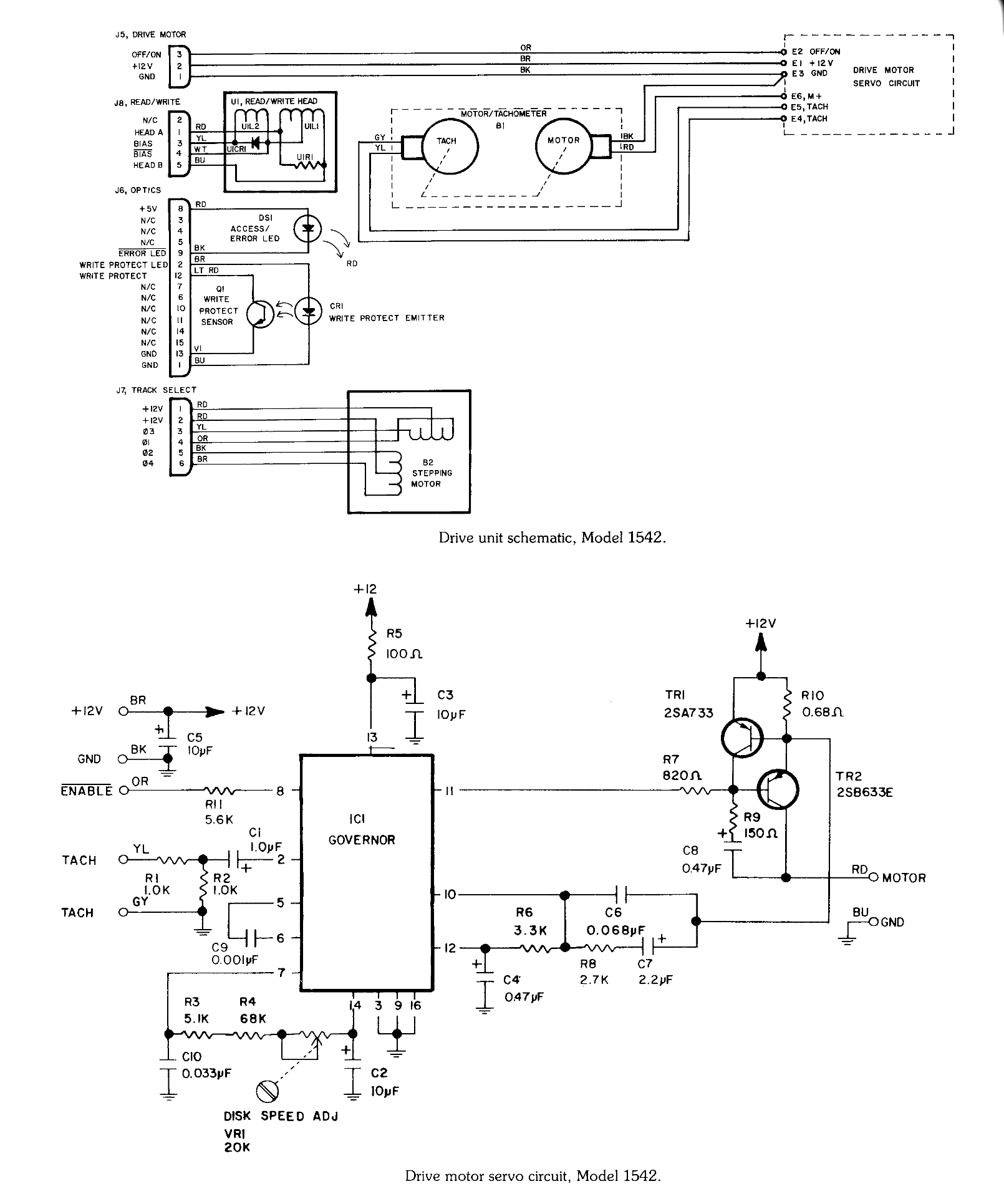
I decided I'd like to experiment with using the Commodore 1541 5 1/4" for truly floppy audio. To start with, I have disassembled two of them, and gotten rid of the useless, huge, transformer-based power supplies and the motherboard.
Next, I'm taking an information theoretic approach, trying to estimate record time, bit rate, etc.
The original motor speed is approximately 300 RPM. That means 5 revs/second or 200 milliseconds per revolution. There are 35 tracks, so total record time is approximately 7 seconds. Not bad! That's as long as a microdec, no? :)
Anyway, my friend and I were wondering about audio quality. From what I've read, the drive has 17 to 21 sectors per track. Each sector is 256 bytes. This means each track has between (17*256*8=34816) and (21*256*8=43008) bits on it. So, let's work with an average of 38kbits, b/c this is floppy audio, not a mars rover.
So one thing we may want to compute is the bit rate of audio coming off of the disk. It looks like it can stream data about 38k/.2 = 190kbps. Pity the good old C64 couldn't get anywhere that fast!
To estimate audio quality, I would like to plug this number into the Shannon-Hartley theorem which states that C = B*log2(1+S/N), where C = bitrate and B is bandwidth and S/N = linear signal to noise ratio. Note that by comparison, a CD player has a bitrate of approximately 750 kbps per channel, about 4 times better than a 1541!
What is the bandwidth, given: C = 190kpbs and desired S/N > 8-bit, e.g. 256:1? Well B = C/(log2(1+S/N), which is 190k/(~8) ~= 23.750 kHz! That's not bad!
Of course, that's only at 8-bit quality! What if we want, e.g. 12-bit quality? Then B = 190000/(~12) = 16kHz! That's not CD quality, but it's still the highest frequency many can hear! Woo-Hoo! This is encouraging.
However, I should add that this is only a *theoretical maximum* information storage limit. These limits are only approachable in the real-world using complex modulation schemes. I don't plan to do any of that! It's floppy audio, not a robot-guided stent.
On the other hand, the original drives had more bits on there for framing purposes, which means the bandwidth of the medium may a bit greater. It looks like they used 5 bits to encode 4, so bandwidth may be up to 25% greater (half a bit!) than base estimation.
Ok, that wraps up tonight's exploration. My drives are 10 miles away in my studio and I'm going to get a good night's rest. Here's the summary of my first exploration of using the Commodore 1541 5 1/4" floppy drive for audio:
Total record time: 7 seconds ( 35 loops of 200 milliseconds each)
Maximum frequency at 12-bit quality: 16kHz
--
http://diydsp.com http://diydsp.com ? http://diydsp.com !
I've been watching this thread with interest as well as Jeri Ellsworth's video.
I decided I'd like to experiment with using the Commodore 1541 5 1/4" for truly floppy audio. To start with, I have disassembled two of them, and gotten rid of the useless, huge, transformer-based power supplies and the motherboard.
Next, I'm taking an information theoretic approach, trying to estimate record time, bit rate, etc.
The original motor speed is approximately 300 RPM. That means 5 revs/second or 200 milliseconds per revolution. There are 35 tracks, so total record time is approximately 7 seconds. Not bad! That's as long as a microdec, no? :)
Anyway, my friend and I were wondering about audio quality. From what I've read, the drive has 17 to 21 sectors per track. Each sector is 256 bytes. This means each track has between (17*256*8=34816) and (21*256*8=43008) bits on it. So, let's work with an average of 38kbits, b/c this is floppy audio, not a mars rover.
So one thing we may want to compute is the bit rate of audio coming off of the disk. It looks like it can stream data about 38k/.2 = 190kbps. Pity the good old C64 couldn't get anywhere that fast!
To estimate audio quality, I would like to plug this number into the Shannon-Hartley theorem which states that C = B*log2(1+S/N), where C = bitrate and B is bandwidth and S/N = linear signal to noise ratio. Note that by comparison, a CD player has a bitrate of approximately 750 kbps per channel, about 4 times better than a 1541!
What is the bandwidth, given: C = 190kpbs and desired S/N > 8-bit, e.g. 256:1? Well B = C/(log2(1+S/N), which is 190k/(~8) ~= 23.750 kHz! That's not bad!
Of course, that's only at 8-bit quality! What if we want, e.g. 12-bit quality? Then B = 190000/(~12) = 16kHz! That's not CD quality, but it's still the highest frequency many can hear! Woo-Hoo! This is encouraging.
However, I should add that this is only a *theoretical maximum* information storage limit. These limits are only approachable in the real-world using complex modulation schemes. I don't plan to do any of that! It's floppy audio, not a robot-guided stent.
On the other hand, the original drives had more bits on there for framing purposes, which means the bandwidth of the medium may a bit greater. It looks like they used 5 bits to encode 4, so bandwidth may be up to 25% greater (half a bit!) than base estimation.
Ok, that wraps up tonight's exploration. My drives are 10 miles away in my studio and I'm going to get a good night's rest. Here's the summary of my first exploration of using the Commodore 1541 5 1/4" floppy drive for audio:
Total record time: 7 seconds ( 35 loops of 200 milliseconds each)
Maximum frequency at 12-bit quality: 16kHz
--
http://diydsp.com http://diydsp.com ? http://diydsp.com !